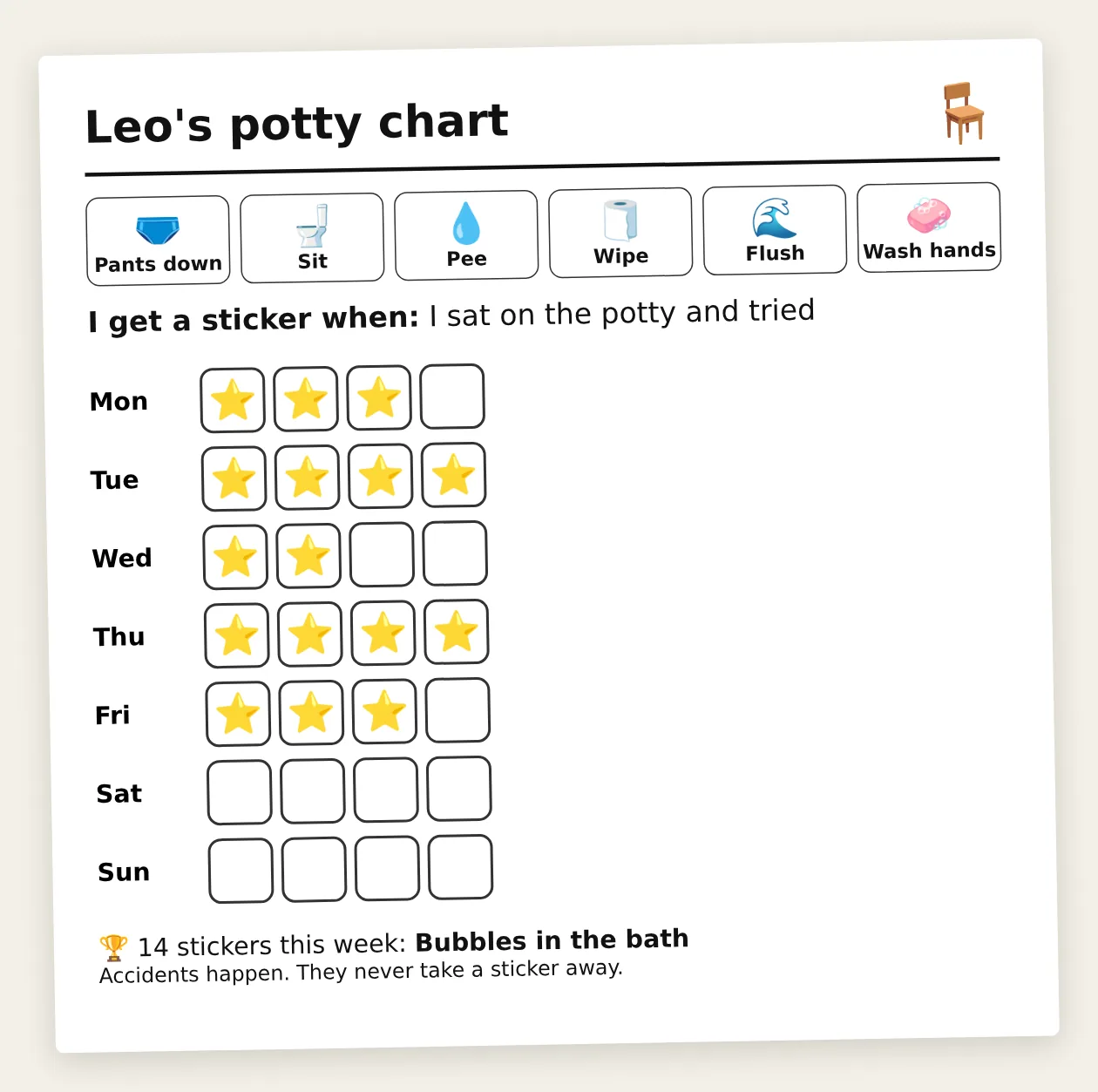
My potty chart
- Pants down
- Sit
- Pee
- Wipe
- Flush
- Wash hands
I get a sticker when:
- I sat on the potty and tried
| Day | Stickers | |||
|---|---|---|---|---|
| Mon | ||||
| Tue | ||||
| Wed | ||||
| Thu | ||||
| Fri | ||||
| Sat | ||||
| Sun | ||||
Make a potty training sticker chart that fits where your child is now: sitting and trying, using the potty, telling you in time, or staying dry all day. Add picture steps for little ones, then print it or save it as a PDF. Free, no sign-up, and nothing leaves your device.
Best for the first days. Reward the sitting and trying, even if nothing happens.
On the chart: I sat on the potty and tried
Starting suggestion: about half the boxes (14 of 28), so a week with a few misses still earns the prize.
Tip: choose "Save as PDF" in the print window to keep a copy. Print a fresh one each week.
I get a sticker when:
| Day | Stickers | |||
|---|---|---|---|---|
| Mon | ||||
| Tue | ||||
| Wed | ||||
| Thu | ||||
| Fri | ||||
| Sat | ||||
| Sun | ||||
A potty training chart is a sheet where your child gets a sticker for each step forward, like sitting on the potty or doing a wee in it. It turns praise into something they can see, and a small prize at the end gives them something to look forward to.
| Stage | Sticker for | When to use it |
|---|---|---|
| Sitting and trying | Sitting on the potty, even if nothing happens | The first days |
| Using the potty | A wee or poo in the potty | Once sitting is easy |
| Telling you in time | Saying "I need to go" | When they still need reminding |
| Dry pants all day | A whole day dry | When most days already go well |
Moving through the stages keeps the chart winnable. A child who only gets stickers for dry days can go a whole week with nothing, and that's when charts stop working.
Accidents are a normal part of learning. Stay calm, clean up together and move on. Never take a sticker away; an accident just means no sticker that time. If accidents suddenly increase after a good run, look for a change at home or nursery, and think about stepping back a stage for a week.
The American Academy of Pediatrics advises against using treats as potty training rewards. Small, simple prizes work well: choosing the bedtime story, bubbles in the bath, a trip to the park or a song to dance to. The maker has a few ideas to tap.
Talk to your doctor or health visitor if your child's poos are hard or painful, if your child is holding on, or if you're worried about progress at any point. The NHS advises getting help with constipation before stopping nappies. Children with additional needs can learn toileting skills too; they may need more time and support.
For other habits like bedtime or tidying up, use the reward chart maker.
They can help as a way to praise effort and show progress. The NHS suggests praising your child for trying, whether or not anything happens, and lists stickers and reward charts as one way to do it. The American Academy of Pediatrics warns against using treats as rewards, so keep prizes small and not food. A chart works best alongside calm, specific praise.
Start by rewarding sitting and trying, not only success. The bladder and bowel charity ERIC recommends rewarding the sitting and trying rather than the wee or poo itself. Move on to rewarding using the potty, then telling you in time, then dry days, as each step gets easy.
Keep the first prize close. The maker suggests 5 stickers on a sticker trail for a 2-year-old, or about half of the boxes on a week tracker, so a week with a few misses still earns the prize. Make the next chart longer once your child is doing well.
No. Accidents are a normal part of learning, so stay calm, clean up together and move on. The chart only ever adds stickers; an accident simply means no sticker that time.
There's no single right age. The AAP says signs of bladder and bowel control usually appear between 18 and 24 months, and most US children start between 2 and 3 years. The NHS says almost all children can be potty trained between 18 months and 2 and a half years. Go by your child, not the calendar.
We don't include a dry-night sticker on purpose. Most children learn to stay dry at night after they are dry in the day, and it isn't something a child can control by trying. If you're worried about bedwetting, talk to your doctor or health visitor.
Only in your own browser, so your settings are there next time. Nothing is sent to us.
This page gives general information, not medical advice. If you're worried about your child's toilet training, talk to your doctor or health visitor.
Last reviewed: by Ali Haider